Engineering Internals
This document is for developers contributing to or extending DbxSmith. It covers repository structure, the reasoning behind key engineering decisions, and detailed lifecycle diagrams for the runtime entry and teardown phases.
I. Repository Structure
| Path | Category | Description |
|---|---|---|
install.sh | Entrypoint | Quick-start installer and shell injector. |
bin/ | Executables | dbx-smith-dash (TUI), dbx-smith-spin (Spin), dbx-smith-rm (RM). |
src/ | Runtime | dbx-smith.sh — shell-integrated core logic, completions, alias loader. |
internal/ | Metadata | Design docs and templates (not shipped to users). |
docs/ | Docs Site | Docusaurus source for the public documentation. |
Makefile | Distributor | Deterministic mapping of files to host paths. |
Distribution paths (Makefile)
| Layer | Path | Content |
|---|---|---|
| Execution | ~/.local/bin/ | dbx-smith-dash, dbx-smith-spin, dbx-smith-rm, dbx-smith-uninstall |
| Persistence | ~/.config/dbx-smith/ | dbx-smith.sh, registry/, aliases.d/ |
| Shell | ~/.bashrc or ~/.zshrc | source ~/.config/dbx-smith/dbx-smith.sh |
II. Engineering Principles
💡 IDEMPOTENCY
Every script is safe to re-run. Existence checks before mkdir, || true guards on network ops, and command -v checks before installing prevent duplication on partial failures.
2. Loose Coupling — The Fallback Pattern
The runtime (dbx-smith.sh) is loosely coupled with the registry. If the registry is deleted, it falls back to inspecting /etc/passwd inside the container for ghostuser. Tools should degrade gracefully, not crash.
📘 VISUAL DETERMINISM
Terminal colors are derived from the image name via cksum, not randomly assigned. The same image always produces the same color — a security feature that prevents running commands in the wrong terminal window.
III. The Entrypoint: install.sh
IV. Runtime Entry Lifecycle (dbx-smith)
What happens every time you run dbx-smith <box> after provisioning.
V. Interactive Mission Control (dbx-smith-dash)
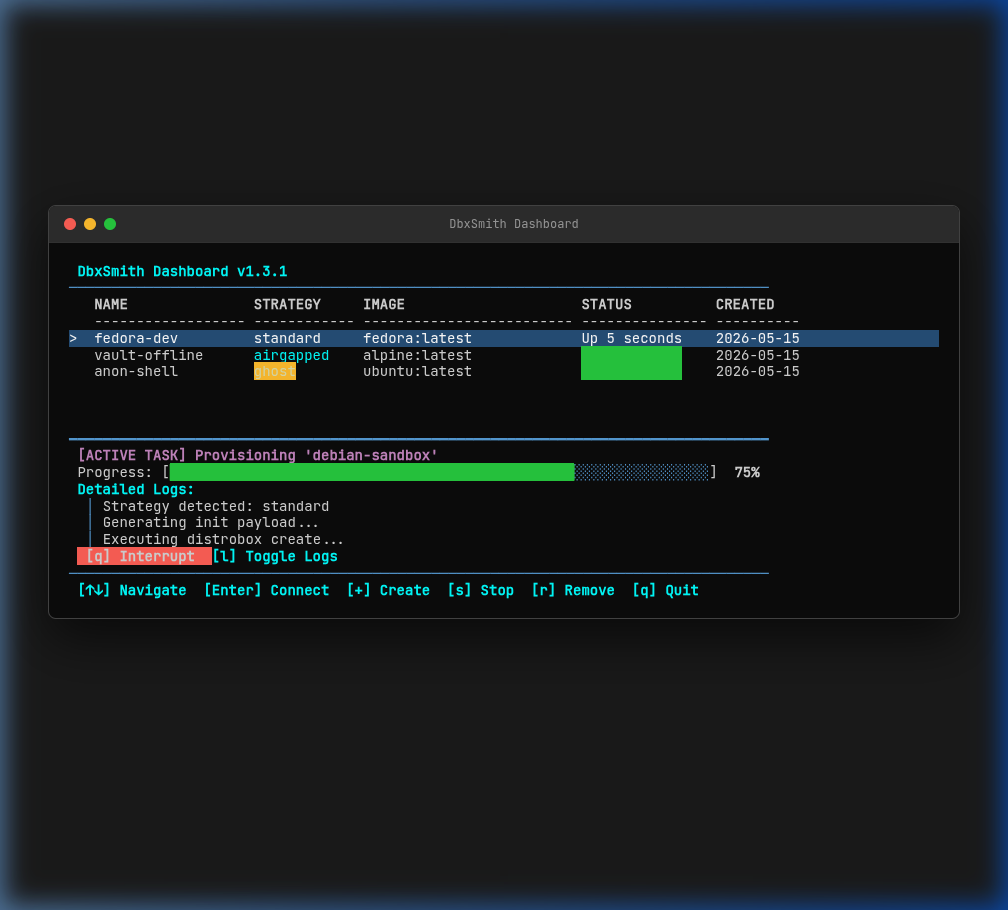
The dashboard is a pure Bash TUI designed for sub-second responsiveness and zero flickering.
VI. Destruction Lifecycle (dbx-smith-rm)
VII. Advanced Engineering Details
For a deep dive into how DbxSmith handles shell hooks, cross-distro environment persistence, and the Ghost identity engine, see the Shell Configuration Engineering guide.
1. Zero-Escape Payload Injection (Base64 Tunnelling)
Passing complex scripts into distrobox create --init-hooks causes double shell evaluation — the host shell consumes >>, $, and " before they reach the container.
Solution: Encode the entire script as Base64 on the host. The host sees only alphanumeric characters. The container decodes and executes it fresh.
payload=$(printf "%s" "$script_content" | base64 | tr -d '\n')
hook="echo '$payload' | base64 -d | sh"
distrobox create --init-hooks "$hook" ...
2. The Freeze/Rebuild Airgap (The Phoenix Cycle)
Distrobox's first-run initializer needs internet access to install sudo and mount inside the guest. A container created with --network none immediately fails this step. Rootless Podman also makes it difficult to dynamically sever existing bridges from the host.
Solution: The Phoenix Cycle Instead of fighting the engine, DbxSmith uses a two-phase provisioning flow:
- The Larva Phase: Create a standard container with network access. Run
distrobox enteronce to trigger the guest package manager and installiproute2andsudo. - The Chrysalis Phase: Perform a
podman committo save the fully-provisioned guest state as a new, immutable image (dbx-frozen-<name>). - The Phoenix Phase: Atomically destroy the "Larva" container and re-create it using the "Frozen" image with the
--network noneflag explicitly set.
This guarantees that the box is physically airgapped from its first interactive second, without requiring complex host-side firewall rules.
3. Exact-Match Container Validation
Simple grep "test" on distrobox list matches test-vault, test-old, etc. — false positives that cause accidental deletions.
Solution: Use awk with field-level equality on column 3 (the NAME column):
distrobox list --no-color | awk -v name="$name" 'NR>1 && $3==name {found=1} END {exit !found}'
Used in spin (duplicate guard), runtime (existence check), and rm (target validation).
4. True Tmpfs Home Isolation (The Eclipse Hack)
Distrobox enforces a strict behavior: it always bind-mounts the host's default home directory (e.g., /home/username) into the container. Even if you pass a custom --home ~/boxes/mybox flag, Distrobox maps your root /home into the container, exposing SSH keys and .bash_history.
The Naive Failure:
If we attempt to forcibly remove it (umount /home) via an init-hook, Distrobox often crashes or throws permission errors because its internal bootstrapping relies on that path existing. We cannot fight Distrobox to remove the mount.
Solution: The Eclipse (Over-mounting) Instead of removing it, DbxSmith uses a Linux trick: Over-mounting. When you mount a filesystem onto a directory that already contains files, the original contents become completely "eclipsed" or hidden underneath the new mount.
DbxSmith injects a multi-stage tmpfs hack via init-hooks before the container shell starts:
# 1. Save the intended custom home directory
mkdir -p /tmp/save_home
mount --bind "$HOME_BASE/$name" /tmp/save_home

# 2. THE ECLIPSE: Obliterate host visibility by over-mounting /home entirely in RAM
mount -t tmpfs tmpfs /home

# 3. Restore ONLY the custom home directory back into the empty RAM disk
mkdir -p "$HOME_BASE/$name"
mount --bind /tmp/save_home "$HOME_BASE/$name"
umount /tmp/save_home
The new, empty tmpfs RAM disk is placed directly on top of /home. The host's /home still technically exists underneath, but it is now 100% inaccessible to any user or process inside the container. We bypass the hardcoded volume mapping without breaking the container lifecycle.
For Ghost strategies, it is even simpler: the tmpfs is mounted over /home, and then /home/ghostuser is created ephemerally inside the RAM disk. When the container halts, the RAM disk evaporates, guaranteeing zero traces are left on the host.
VIII. Testing Framework Architecture
The DbxSmith testing suite (test.sh) is built on a Decoupled Master/Slave Orchestrator Architecture. It is designed to evaluate a massive cross-distribution matrix (Alpine, Arch, Fedora, Ubuntu) across every single isolation strategy dynamically, without hardcoding test cases.
1. Dynamic Plugin Discovery
The testing framework uses a plugin system to discover what to test:
- Distro Plugins (
tests/distros/*.conf): Each.conffile defines aDISTRO_NAMEandDISTRO_IMAGE. The master orchestrator (test.sh) automatically iterates over all valid configurations. Adding Debian support to the test suite is as simple as dropping adebian.confinto this directory. - Strategy Plugins (
tests/strategies/*.sh): The orchestrator scans this directory to discover the test logic for each strategy type.
2. Master / Slave Execution Model
Because isolation strategies permanently sever network connections or manipulate host routing, test assertions cannot be evaluated sequentially in a single environment.
- The Master (
test.sh): Runs on the host. It parses arguments (like--full), discovers plugins, and dispatches a separate "Slave" process for each Distro/Strategy combination. It acts purely as a lifecycle manager and report generator. - The Slave (
tests/common/slave_runner.sh): The actual test execution boundary. The slave is responsible for provisioning the container using the specified strategy, executing the targeted assertions (tests/strategies/<strategy_name>.sh), and tearing the container down atomically. If a slave crashes or times out due to an infinite loop (Watchdog timeout), the Master intercepts the failure, kills the slave, and cleanly moves to the next matrix permutation.
3. Assertion Scoping (_exec_in_box)
The core testing assertion wrapper (_exec_in_box inside tests/strategies/common_asserts.sh) utilizes raw podman exec calls instead of the high-level dbx-smith entrypoint.
This provides two major advantages:
- Unbuffered Speed: Bypassing the wrapper logic reduces the assertion execution time by >60%.
- Dynamic Workdir Validation: The wrapper intelligently evaluates the target strategy. If asserting against a
ghostidentity, it enforces--workdir /home/ghostuser. If standard, it maps/home/ubuntu. This guarantees that OCI runtime pathing errors are exposed explicitly during CI testing.